
Item No. 3 “Lock No. 1 New Welland Canal and Harbor at Port Dalhousie, Canada.” Sykes Fonds RG 341 – Welland Canal Scrapbook/Photographs
From the visual cues, the title of the postcard, and the message on the back, this postcard describes the history of Niagara that is unique. Visually the card is impressive, a hand-coloured image with a beautiful view of the canal and daily life. The colours are aged with time but remain vibrant in the sky, grass, and water, brightening the image.
The location depicted here was Lock 1 of the Welland Canal in Port Dalhousie. In total there were 4 different Welland Canals built, the first being constructed in 1829. These canals boosted Niagara’s economy as it opened a transportation corridor that allowed for the travel of goods and people and supplied many jobs.
However, this history has a darker side as multiple workers and animals alike were injured or lost their lives during construction. Horses played a major part in the history of the Welland Canal—from powering the equipment used to dig the canals to pulling ships, these animals workers served an important role until they were replaced by steam powered vessels in the late 19th century. These horses suffered incredibly difficult weather and work conditions, pulled heavy loads, and suffered from neglect, whippings, and were labelled as “miserable beings.” [1] The horses visible in this card are cart horses and likely didn’t have as bleak of an existence as the tow horses did. However, their presence alongside the human figures in this image is a reminder of this shared human-animal history.
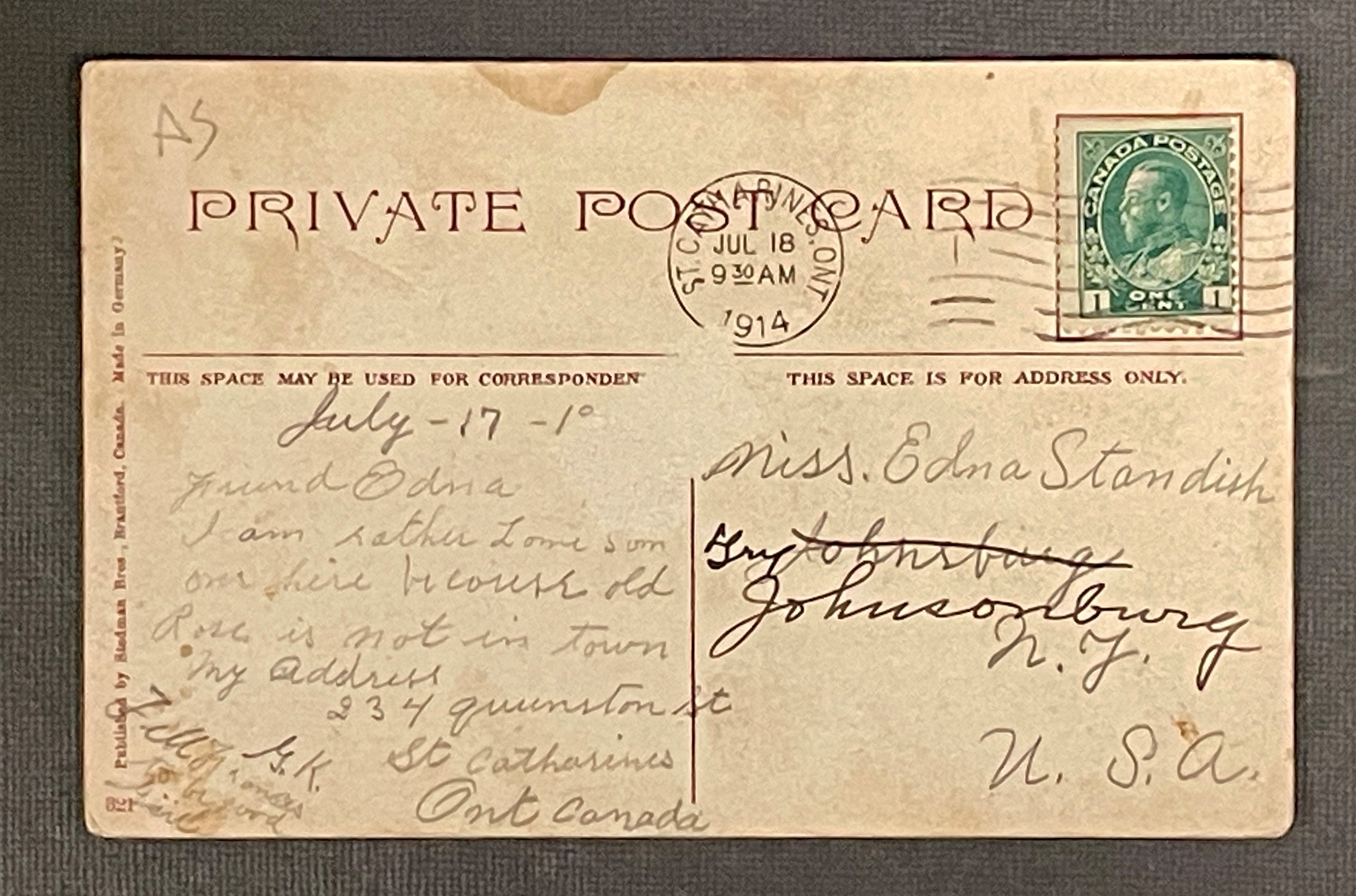
Handwritten messages on the backs of postcards turn items like this from mass-produced forms of visual culture to objects that hold personal meaning. Research conducted at the St. Catharines Public Library provided further information about the sender of this card. Walter Bray wrote this message to a woman named Miss Edna Standish from Johnsonburg New Jersey. Bray lived at 234 Queenston St. in St. Catharines, and he wrote this note on July 17, 1914 [2]. It reads: “Friend Edna, I am rather lone sum over here because old Rose in not in town. My address [is] 234 Queenston St. St. Catharines Ont Canada.” There are many unanswered questions about the interaction that the city directory or other sources cannot explain. Who was Miss Standish to Mr. Bray and what was their relationship? Even without these answers, getting a glimpse at this small interaction reminds us that history is shaped by countless personal stories.
-Text by Daniella Alexander (VISA 2P90)
*This image is part of the “Women, Water, and Words” exhibition that students in VISA 2P90 curated in the Winter 2024 semester.
Notes
[1] Keri Cronin, “The Pull: A Public Monument Commemorating Animal Workers in Port Dalhousie.” NiCHE, March 30, 2023. https://niche-canada.org/2023/02/14/the-pull-a-public-monument-commemorating-animal-workers-in-port-dalhousie/
[2] Vernon’s City Directory, St. Catharines and Thorold, Ontario, 1913. Hamilton, ON: Vernon Directories, 1912.
Further Reading
Cronin, Keri. “The Pull: A Public Monument Commemorating Animal Workers in Port Dalhousie.” NiCHE, March 30, 2023. https://niche-canada.org/2023/02/14/the-pull-a-public-monument-commemorating-animal-workers-in-port-dalhousie/
Gomme, Maurice A., and John Burtniak. Street Names of St. Catharines. St. Catharines, Ontario: M. A. Gomme, 2017.
Jackson, John. “Introduction: The Welland Canal within the World Experience of Canals.” In The Welland Canals and Their Communities. Canada: University of Toronto Press, 1997.
Vernon’s City Directory, St. Catharines and Thorold, Ontario, 1913. Hamilton, ON: Vernon Directories, 1912.
 Keri Cronin