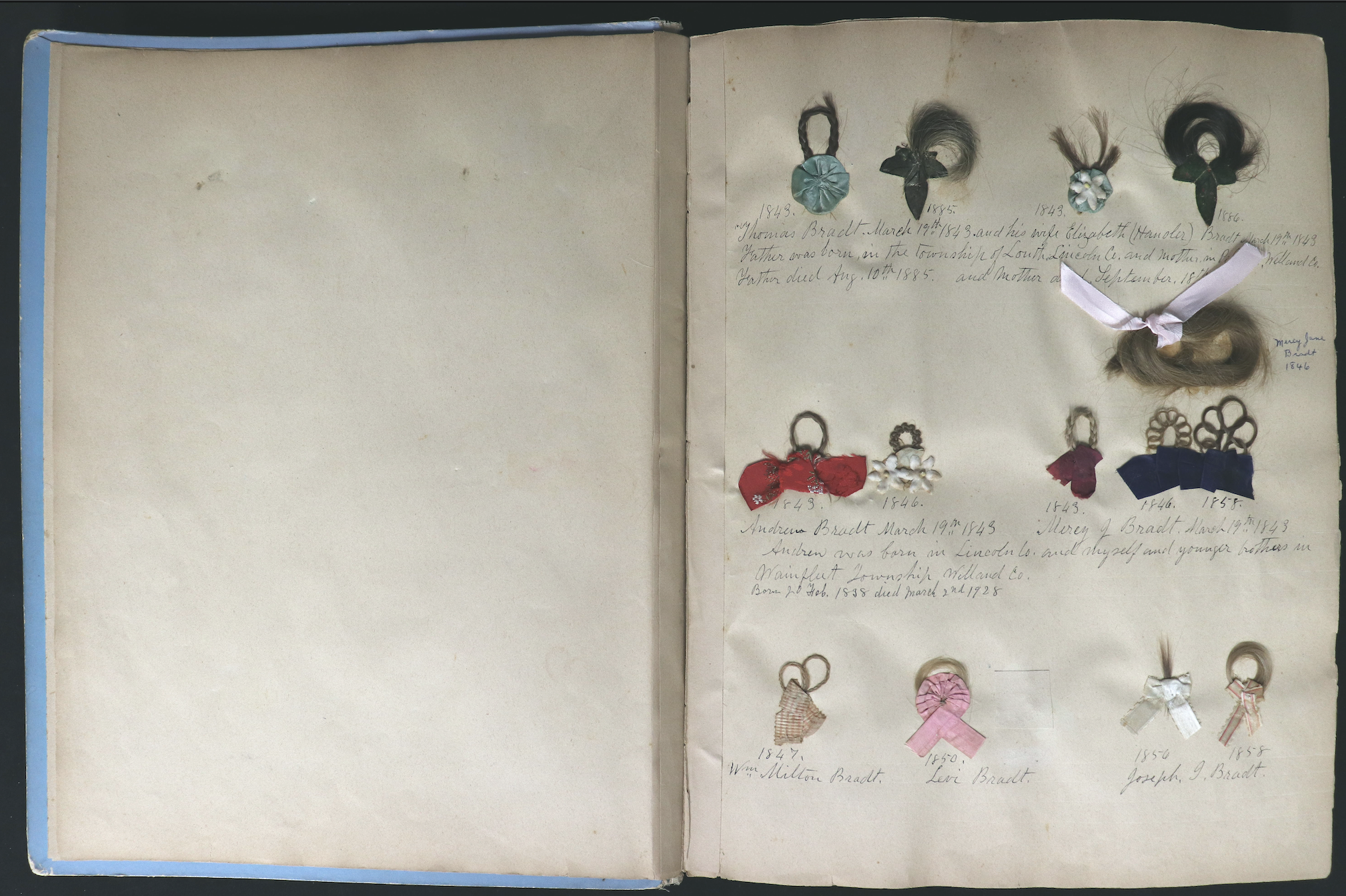
Page from Bradt Family Hair Album, Bradt family fonds Archives & Special Collections-10th Floor-Archives ; 580 RG
This is a page from the Bradt family hair album. This page includes 14 locks of hair: some blond, some brown, some braided. The locks of hair are tied together with ribbon, and this page is typical of the pages found within this album.
This hair album seems like a regular family album on the outside but, on the inside the album contains locks of hair from various generations of the Bradt family. Each lock of hair has either a bow or a pressed flower on it as well as the person’s name and the year that the lock was cut. Some of the hair locks were braided or looped in a decorative way and/or contained birth dates, death dates, place of birth and/or other details.
This album was started in 1843 by Elizabeth (Hansler) Bradt and was passed down to her daughter Mercy J. Dunn in 1899. The family tradition of preserving locks of hair in this way continued on until 1976.
Keeping locks of hair from your loved ones was a common custom in the 19th century.
These locks of hair could be from friends, families, lovers, etc. As staff from The Old Hastings Mill Store Museum in Vancouver have noted, “the constant reality of death in Victorian times that stemmed from various disease epidemics and an overall lack of proper medical knowledge and hygiene, as well as concerns regarding the appropriate way to approach death and grieving, were major factors behind the emphasis on memorialization of the dead.”[1] Hair held a special place in these rituals of mourning. As Elisabeth Gitter, writes, locks of hair can be like “a Midas touch of imagination, something treasured, a totem, a token of attachment, intrinsically valuable, as precious as gold.” [2]
Deborah Lutz has argued that preserving a lock of hair from a loved one is informed by the belief “that the loved one still exists somewhere, somehow”and that it will “mark the continued existence of the body to which it once belonged. To possess a piece of the beloved might provide a link to that body lost; it might comfort with its talisman-like ability to contain, and prove the existence of, an eternity…” [3]
This custom is about emotional intimacy and is a token of love and attachment. With the
pieces of information above, therefore, this hair album is a book of generational records
and love.
The Bradt family originally came from Schenectady, New York as United Empire
Loyalists after the military unit some of their family members served in, broke apart. This
unit was led by John Butler. The Bradt and Butler families, now bound together, moved
to Canada, specifically, Niagara-on-the-Lake, in 1784. The families had been given land
in Canada by the Crown for their years of loyalty. Years later, the Bradt family decided to
settle on a farm in the St. Catharines area.[4]
-Text by Clare DiFelice (VISA 2P90)
*This image is part of the “Women, Water, and Words” exhibition that students in VISA 2P90 curated in the Winter 2024 semester.
Notes
[1] Old Hastings Mill Store Museum, “Old Hastings Mill Store Museum,”
https://hastingsmillmuseum.ca/blog
[2] Elisabeth G. Gitter, “The Power of Women’s Hair in the Victorian Imagination,” PMLA
99, no. 5 (1984): 936–54.
[3] Deborah Lutz, “The Dead Still Among Us: Victorian Secular Relics, Hair Jewelry, and
Death Culture,” Victorian Literature and Culture 39, no. 1 (2011): 127–42.
[4] Brock University Library Archives & Special Collections, Bradt Family Fonds RG580 https://dr.library.brocku.ca/handle/10464/12564
Further Reading
Brock University Library Archives & Special Collections, Bradt Family Fonds, 1796-1976 RG 666 https://dr.library.brocku.ca/handle/10464/13849
Brock University Library Archives & Special Collections, Bradt Family Fonds RG580 https://dr.library.brocku.ca/handle/10464/12564
Gitter, Elisabeth G. “The Power of Women’s Hair in the Victorian Imagination,” PMLA 99, no. 5 (1984): 936–54.
Lutz, Deborah. “The Dead Still Among Us: Victorian Secular Relics, Hair Jewelry, and
Death Culture,” Victorian Literature and Culture 39, no. 1 (2011): 127–42.
Miller, Nancy K. “Family Hair Looms,” Women’s Studies Quarterly 36, no. 1/2 (2008):
162–68.
Old Hastings Mill Store Museum, “Old Hastings Mill Store Museum,” Old Hastings Mill
Store Museum, accessed February 27, 2024, https://hastingsmillmuseum.ca/blog
 Keri Cronin